Solid Wood Cabinetry — Oak, Maple & Cherry in Huntsville, AL
Huntsville Quality Kitchen Cabinets builds solid wood kitchen cabinets in Huntsville, AL using species chosen for both their appearance and their ability to handle North Alabama's heat and humidity.
Solid Wood Cabinetry Built for How Huntsville Homes Actually Live
Solid wood cabinets are the highest-quality option you can put in a kitchen — but only if the wood is chosen correctly, dried properly, and finished for the environment they'll live in. A cabinet built for dry Colorado air will behave differently in a Huntsville kitchen in August.
We use kiln-dried hardwoods with a target moisture content of 6–8% — close to what equilibrated wood will settle at in a conditioned North Alabama home. This is important. Wood that's installed at too high or too low a moisture content will move after installation, causing gaps, swelling, and finish cracking. We dry it right so it stays right.
Every species we offer has different characteristics — grain pattern, hardness, staining behavior, response to humidity. Below is what you actually need to know about the three we build with most often.
Hard Maple — The Painter's Wood
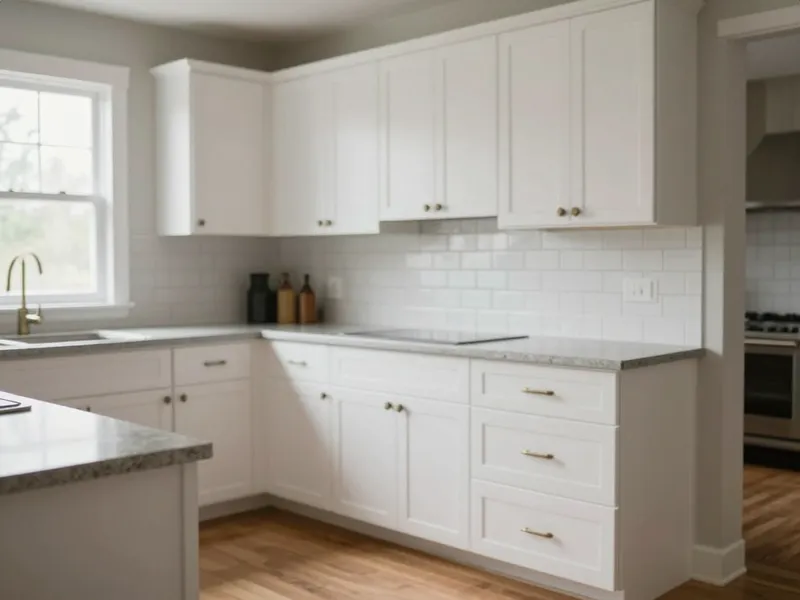
Hard maple is our most-requested species for painted kitchens. It has a tight, uniform grain with almost no texture variation — which means paint goes on smooth and stays smooth. There are no pores or open grain to telegraph through the finish after a few years.
It's also one of the hardest domestic hardwoods we work with — 1,450 on the Janka hardness scale, harder than oak and cherry. That matters for drawer fronts and door edges that take daily contact. Maple holds its edges clean and resists denting at cabinet corners.
Maple does have natural color variation and can have occasional mineral streaks. In stained applications, this variation can show as uneven tone. Most of our clients who want a stained natural look choose oak or cherry instead. Maple's home is painted cabinetry — and it's exceptional at it.
Hardness
1,450 Janka
Best For
Painted finishes
Color
Creamy white to light tan
Humidity Rating
Very stable when finished
Red & White Oak — The Classic Grain
Oak is the most widely used cabinet wood in North America for good reason. It's strong, relatively affordable compared to cherry and walnut, and has a strong grain character that shows well in stained finishes. Red oak has a warm pinkish undertone. White oak runs cooler with more tan and grey.
Oak has an open grain — meaning you can see the pores in the wood surface. In stained finishes, these pores fill with stain and create depth. In painted finishes, they require grain filler before priming or the pores telegraph through the paint over time. We apply grain filler on all painted oak work as a standard step.
For North Alabama kitchens, white oak has gotten significantly more popular in the last five years — particularly in Madison and Hampton Cove new-construction homes. The cooler, greyer tone works well in modern and transitional kitchens with quartz countertops and stainless appliances.
Hardness
1,290 Janka (red)
Best For
Stained finishes
Color
Light tan to warm rose
Humidity Rating
Good — grain movement minimal in conditioned spaces
Cherry — The Wood That Gets Better With Age
Cherry is our premium stained-finish option. It starts light — almost pinkish-blonde — and darkens significantly over the first year or two of exposure to light, developing a rich reddish-brown that most clients find more beautiful than the original. If you're looking at cherry sample boards in the shop, know that what you'll actually have in five years is richer and warmer.
Cherry has a fine, consistent grain with minimal variation, which makes it ideal for formal and transitional kitchens where you want a rich, elegant look without the rustic character of oak. It's softer than maple and oak — 950 Janka — which means it can pick up small dents over time in high-use areas. It machines beautifully and takes finish exceptionally well.
One thing to know about cherry in Huntsville: it's a wood that responds to humidity. We seal cherry cabinets with a moisture-cured catalyzed finish on the interior surfaces as well as the exterior — not just the face and doors. This is critical for long-term stability in Alabama summers.
Hardness
950 Janka
Best For
Stained — warm/formal
Color
Light pink → rich reddish-brown
Humidity Rating
Needs proper sealing on all surfaces
How We Build Solid Wood Cabinets
Construction quality matters as much as species choice. Here's what we do differently from mass-produced solid wood options.
The same craftsmen who mill the lumber in our Huntsville shop are the ones who install your cabinets. That continuity of care — from raw lumber to final adjustment — is what makes the difference in a cabinet that holds up for decades.
Plywood Box Construction
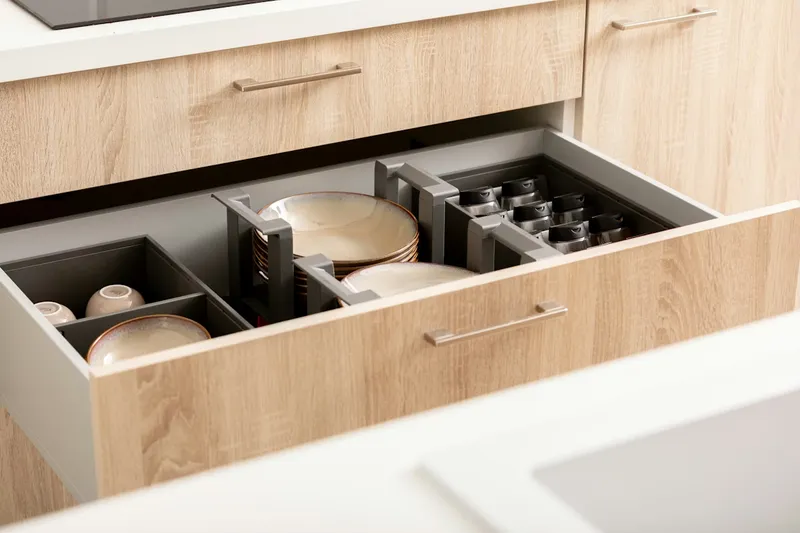
We use furniture-grade plywood for the cabinet boxes — not particleboard. Plywood is cross-laminated, which means it resists racking and moisture movement. Particleboard swells at the bottom of base cabinets when exposed to even minor moisture.
Solid Wood Face Frames
Face frames are built from the same species as the doors, not a painted or stained poplar substitute. This ensures consistent color and grain between the frame and the doors throughout the life of the cabinet.
Dovetail and Mortise-Tenon Joinery
Drawer boxes are built with hand-cut or machine-cut dovetail joints — the strongest mechanical joint for a box under repeated load. Door frames use mortise-and-tenon construction that stays tight without relying solely on glue.
Catalyzed Finish on All Surfaces
We apply a moisture-cured catalyzed lacquer or conversion varnish that creates a hard, chemical-resistant film. Not a water-based finish that softens near the dishwasher, and not a wax finish that requires periodic renewal.
Interested in sustainably sourced wood? We offer FSC-certified lumber options and low-VOC finishes for clients who want responsibly sourced cabinetry. See our Eco-Friendly & Low-VOC Cabinetry page for the full details.
Let's Pick the Right Wood for Your Kitchen
We bring samples to your home so you can see how each species looks in your actual kitchen lighting before making a decision.